I love Heliot Ramos. In 2024, his breakout season, I decided he would be my new favorite baseball player after enduring years of listless Giants teams. I created a mini-shrine for him with autographed and jersey patch cards, and game-used and autographed balls.
Unfortunately, he’s now a Yankee. However, I feel happy for him and the Giants.
On the surface, you might ask why. He is:
A homegrown San Francisco Giant and a 2024 All-Star.
A player with huge power—the only right-handed hitter ever to reach McCovey Cove with a home run during a game.
By every public indication, a genuinely good guy—and certainly someone I enjoyed rooting for.
Still early in his career, with three more years of team control after 2026. Teams usually retain young, productive players because they are relatively affordable and can contribute for years.
Ramos was also a poor, but recently improving, left fielder, an average baserunner, and a hitter who had not quite translated all of his ability into consistent production.
For the Giants, however, it made sense. Ramos was an above-average, but not star-level, hitter playing the least demanding defensive outfield position – roughly the outfield equivalent of first base. Center fielders must cover far more ground and are therefore much harder to find, while teams can often place a strong hitter with limited range in left field.
The Giants have several plausible ways to replace some of that offense in left field:
Casey Schmitt started learning left field this year while breaking out as a hitter, ranking above the 90th percentile in expected batting average and expected slugging. He is an exceptional third baseman, but Matt Chapman blocks him there, and he can also play second base.
Victor Bericoto has played really well since being called up earlier this year but is injured at the moment. In a very small sample, 59 plate appearances, he hit .293/.305/.552 with four home runs, good for a 138 OPS+. He’s only walked once so far, however, but had a solid 7.6% walk rate in AAA this year. His scouting profile has long centered on good power and defensively, he looks reasonably athletic with a strong throwing arm.
Parks Harber is now in Triple-A and has produced a 131 wRC+ in Double-A and a 157 wRC+ in Triple-A. He could become a legitimate major-league hitter, but he still needs a defensive home.
Outfield prospects Bo Davidson, now in Triple-A, and Dakota Jordan, now in Double-A, also provide longer-term possibilities. Both currently play center field in the minors but could eventually move to a corner.
In summary, there is at least one reasonable option at LF next year, with other developing options. Center field is by far the bigger problem. They do not need one player to reproduce Ramos exactly. They just need enough offense across the roster to permit a more defensively useful outfield. Ramos was valuable, but the type of value he provided was easier to replace than the athleticism and defense the Giants still need in center field.
From the Yankees’ perspective, Ramos’s surface numbers looked ordinary this year: a .264 batting average, nine home runs in 74 games, and roughly league-average overall production. His underlying contact metrics, however, describe a hitter with considerably more offensive potential:
In plain English, when Ramos made contact, he hit the ball harder and more productively than almost every hitter in baseball, even though his overall results looked average.
Critics can reasonably point to Ramos’s poor walk rate. But the decline was not isolated to him: Adames, Lee, Chapman, Devers and Schmitt also walked substantially less this season. That suggests the Giants may have encouraged a more aggressive, contact-oriented approach, although it is difficult to separate coaching from individual execution. Ramos had already spent 2025 searching for a different balance, walking more often and regularly batting leadoff but producing less power.
I believe the Yankees offer him a credible opportunity to turn those tools into more consistent production for several reasons:
The clearest explanation for the gap between Ramos’s contact quality and his results is that he hit too many balls on the ground this year. His ground-ball rate had previously been near the league average at roughly 44%. This year it climbed to 53%.
His average launch angle fell from 10.4 degrees in 2024 and 11.5 degrees in 2025 to approximately 6 degrees in 2026. His pulled airborne-contact rate fell from 11.9% in 2024 and 14.3% in 2025 to roughly 9.7% in 2026. If he can return to his previous launch profile, more of that elite contact should become extra-base hits and home runs. Yankee Stadium could amplify the improvement, although elevating the ball is the more important variable.
Ramos has a career .279/.345/.501 line against left-handed pitching, including an extraordinary .370/.439/.750 season in 2024.
He has not been as successful against right-handed pitching, but in 2025 he hit .260/.333/.392 with a 106 wRC+, showing that he can be at least an average hitter without the platoon advantage.
Yankee Stadium is also a much more favorable home-run environment. Its home-run park factor is 119, compared with 79 for Oracle Park, with 100 representing a neutral stadium. The full difference will not necessarily apply to a right-handed hitter such as Ramos, but moving out of one of baseball’s most suppressive parks should give his power more room to translate into actual home runs.
Trent Grisham is the Yankees’ primary center fielder and remains a legitimately strong defender, with two Gold Gloves. Grisham can cover more ground in center, allowing Ramos to remain in a corner and reducing the amount of difficult territory the overall outfield must ask him to handle.
Ramos will also join a much deeper lineup featuring Aaron Judge, Ben Rice and Cody Bellinger. He can hit lower in the order instead of serving as a primary run producer. The Yankees can use him more selectively, particularly against left-handed pitching, while giving him time to work through adjustments.
Ramos still seems unfinished as a hitter. Over the past three years, he has shifted between emphasizing power, making more contact and getting on base without finding a stable balance. He has the physical tools to become a very good hitter, and I believe the Yankees may give him the structure and role to find that balance.
In the end, I am excited for him and the Giants, and I’ll continue following him closely.
If I’m honest, however, if I were the Warriors, I wouldn’t go for Giannis and I wouldn’t simply make the pick.
Giannis is still great, but he is no longer the easy “trade everything and figure it out later” bet. He turns 32 this year, would handicap the Warriors in both salary cap and future assets, and likely turns the trade into some version of Butler for Giannis plus most of the remaining draft capital. That may raise the ceiling, but it also narrows every other path.
Making the pick has the opposite problem. The No. 11 pick is valuable, but the realistic good-case version of that player probably joins the rotation right away. That is useful, but it does not necessarily boost the Warriors back to contention. The Warriors do not just need another young player. They need another 16-game player: someone who can stay on the floor in a real playoff series.
Instead, I would use that pick, and potentially others, to bring in a young, good-contract player who might have a Nickeil Alexander-Walker unlock in him.
That means the ideal target is already a 16-game player, or close enough that the Warriors are not betting on a totally new player. In the right role with the Warriors, he could become a premium starter.
This would allow the Warriors to keep their core players and add more talent. They need to add more 16-game players, not just swap existing ones for better ones. Butler for Giannis is still a swap. It makes the top better, but it may not make the whole playoff rotation good enough.
The better question is where being aggressive has the best expected value.
Using No. 11 on a rookie keeps the asset cheap, but it asks an old team to wait. Even if the pick hits, the most likely timeline is Year 2 or Year 3. The Warriors need playoff minutes now.
Trading everything for Giannis is the opposite problem. Giannis is good enough, but the cost may solve one problem while creating several others: no depth, no flexibility, no future picks, and very little margin for age or injury.
That leaves a third path: use the pick(s) as currency for a player who is already closer to playoff usefulness than the average rookie, but still young enough to have another level.
This is an optionality strategy, not just a talent strategy: the Warriors are trying to add a player who can help now without closing off the next move.
If the Warriors trade one or two picks for the right young player, they can still keep most of the roster intact, retain existing talent, and give themselves time to see whether the player scales in a bigger role. If he does, they found a premium starter before the market fully priced him. If he does not, they still have a movable player, some remaining draft capital, and a path to the next deal.
That is very different from the Giannis path. With Giannis, the Warriors may get the best player in the trade, but they also lose most of their optionality. The assets are gone, the cap is tied up, and the team becomes dependent on an aging superstar staying healthy and drama-free deep into a max contract.
That is why the price matters. One pick is a bet. Two picks is an aggressive bet. Three picks is only for someone with a real chance to become a premium starter. Four picks is only for someone who already looks close to that level.
The process was:
Start with contract value. The player had to be under roughly $20 million, young enough to still improve, and ideally controlled (including restricted rights) for at least two more seasons. I removed players who are restricted free agents this summer because they are harder to acquire cleanly and likely require sending real salary back.
Look for a reason the other team might say yes. A good young player on a cheap deal is not available just because the Warriors want him. There needs to be a forcing function: apron pressure, a coming extension crunch, a position logjam, a roster reset, or a larger star-trade scenario.
Filter for playoff utility. I did not want bad-team stat producers or prospects who need three things to improve before they matter. The player needed at least one bankable playoff skill today: defense, shooting, size, decision-making, rim protection, or real secondary creation.
Rank
Player
Upside rank
Contract
Why Their Team Says Yes
Price – First Round Picks
1
Anthony Black
3
$10.1M in 2026-27; extension eligible; 2027 RFA path. (Spotrac)
Orlando is expensive after building around Banchero, Wagner, Bane, and Suggs. Black is the next extension decision, and No. 11 plus another pick asset may help them reset cost/control.
2
2
Zaccharie Risacher
4
Rookie-scale deal; $13M-ish in 2026-27 with team control after. (SI)
Hawks have positional/role congestion and may consider using Risacher as a trade-up or roster-balancing piece. This is more “lost conviction” than cap pressure. (Yahoo Sports)
1
3
Deni Avdija
1
$13.1M in 2026-27, $11.9M in 2027-28; elite surplus deal.
Portland only says yes if it needs pick capital for a Giannis/star package.
OKC is the apron-pressure case, but picks are not naturally attractive to them because they already have too many. They say yes only if this is part of broader consolidation.
3
Ask whether the role is suppressing the talent. The Nickeil Alexander-Walker lesson is not just “find a young player.” It is “find a player who already has NBA-ready skills, but whose current team context does not fully reveal them.” That is different from betting on a raw prospect to become a new player.
Price the bet. I treated this year’s No. 11 pick as the baseline price. From there, the question is how far the Warriors should be willing to go: one pick for a buy-low swing, two picks for a cleaner young playoff player, three picks for a high-confidence unlock, and four picks only for someone who already looks like a premium starter.
The final group is where the player, contract, team pressure, and Warriors asset structure could plausibly line up.
Price is my rough estimate of draft-capital cost, with 1 meaning this year’s No. 11 pick and 4 meaning an aggressive multi-pick package.
The names split into different types of bets.
Anthony Black is the cleanest Nickeil Alexander-Walker-style target. He is not a pure upside swing. He already has size, defense, passing, and enough handle to imagine a bigger role without inventing a new player. The question is whether the shot solidifies. If it does, he could move from useful playoff guard to premium starter.
Zaccharie Risacher is different. He is not a NAW-style player yet. He is more of a distressed former No. 1 overall pick. The case is that Atlanta may have lost some conviction while the original wing-size, shooting, and defense foundation still exists. That is a one-pick bet, not a multi-pick bet.
Deni Avdija is the cleanest player on the list. The issue is not whether he is a 16-game player, it’s whether Portland would ever move him. The only reason this becomes plausible is if the Blazers are trying to make a bigger star move, such as Giannis, and need to convert Deni into pick capital. Four picks is aggressive, but it is coherent because Deni is already close to premium-starter level on a bargain contract – he was an All Star this year who can be a physical, primary scorer and passer and hold his own defensively.
Cason Wallace may be the best true NAW analog after Black. He is on a loaded team, playing a compressed role, with real defense and enough offense to imagine more. The pre-draft case always suggested there might be more guard skill than his role showed. At Kentucky, he shared the ball, played in cramped spacing, and still showed passing, defensive pressure, and enough shooting to project as more than a defensive specialist. Oklahoma City probably knows exactly what it has, and picks are not naturally attractive to a team that already has too many of them.
The distinction between these names is confidence level.
Risacher is a one-pick swing because the upside is real, but the proof is not. Black is worth more because he already has a clearer 16-game foundation and a plausible role unlock. Wallace costs more because the defensive floor is already playoff-grade and the offensive upside may simply be hidden by Oklahoma City’s depth. Deni costs the most because he is not really an unlock bet anymore. He is already the kind of premium starter the Warriors would hope one of these other players becomes.
The framework: the Warriors pay more only when they are buying more certainty, chasing the highest-probability path to adding another 16-game player before the Curry window closes.
If the No. 11 pick stays a pick, the Warriors are betting on development speed. If it becomes part of a Giannis package, they are betting almost everything on one star solving the whole roster. If it becomes the centerpiece for someone like Black, Wallace, Deni, or another young 16-game player, they are making a different bet: that the draft pick is more valuable as a shortcut through the development curve.
That is the middle path I prefer. It’s still aggressive, but it does not require the Warriors to gut the roster, and it does not ask them to wait three years for the pick to matter.
Growing up as a Warriors fan, I would spend every offseason excited for the next new hope in the NBA Draft. I even got to attend the 1994 NBA Draft in Indianapolis, watching the Warriors pick Clifford Rozier, who was… not good. Typical Warriors of that era.
Fast forward to 2026, and the Warriors have the 11th pick. What should the Warriors do, knowing they have championship aspirations and a Social Security-aged core?
This got me thinking about EV, or expected value. The 11th pick in a deep draft suggests a meaningful player, but historically, is this actually true?
How many players in a draft are actually legitimate winning players? What are your odds of getting one? I started with a suspicion that the Warriors should trade the pick, and that the pick was more hype than value.
The Warriors question is actually a broader draft question. At what point does the expected value of a draft pick fall below the value of a player a team could acquire another way? And at what point is the pick more valuable before it becomes an actual player?
Could we look at this like a financial option, where some of the value disappears once the option is exercised?
A draft pick is like an option. Before it is used, it contains many possible outcomes. After it is used, the market starts pricing one actual player. The hope gets marked to market.
That is the draft pick hope trap.
The question of a draft pick is whether it is more valuable as a player or as an asset. If a player with one real playoff trait and a credible path to scale is available, keep the pick. If the board has collapsed into theoretical upside or replaceable depth, trade the pick while it is still hope.
Working on this framework pushed me toward one question: which prospects already have a trait that can survive playoff basketball?
I used NBA draft history to understand what teams should actually be looking for.
First, let’s answer what should your goal be as a GM in the draft?
The real goal is not drafting an NBA player
The first tier of the draft is about selecting star-level talent. After that, if you are looking to win a championship, I think it is about finding what Draymond Green calls “16-game players.”
These are players who belong in a playoff rotation and can be counted on to help you win a championship through all four rounds.
If you are not one of a good team’s top eight players, you are replaceable. As I will show later, the market already has plenty of ways to find that type of player. You can sign him for the minimum. You can find him in the G League. You can take a swing on a player another team gave up on. You can use the taxpayer midlevel. You can trade for him without giving up a premium asset.
That matters because most draft picks do not become stars. Most do not even become top-eight playoff players by Year 3.
Year 3 is a useful checkpoint because teams usually know whether the player is moving toward core playoff value before the expensive decisions begin.
The draft question becomes more specific:
What are the odds that a pick becomes one of those players?
I am defining a 16-game player as someone who can plausibly be one of the top eight players in a serious playoff rotation by the end of Year 3.
That does not mean he has to be a star. It means he has to survive the playoffs. He has to defend, shoot, process, create, rebound, or protect the rim well enough that a good team does not have to hide him when weaknesses get targeted.
That gives us four tiers:
Tier
Label
Definition
0
Below top-8
Not clearly a serious playoff top-eight rotation player by the end of Year 3
1
Playoff top-8
Plausible 6th to 8th man on a serious playoff team
2
Starter
Plausible top-five player or starter on a playoff team
3
Premium starter
Borderline All-Star or better, top-three-caliber player on a playoff team
Most draft analysis treats “he became a rotation player” as a win. I think that is too generous. If the player is outside the playoff top eight, the team can survive without him. It can keep him, churn him, trade him, replace him, or try the next player.
VORP is not the definition of a 16-game player. It is cumulative, regular-season based, and imperfect defensively, but I think it is useful as a rough screen.
I am using 0.5 VORP as a loose reference point. Above that level, a player is at least in the range where we should examine whether he can be a playoff rotation piece.
Does he defend at a playoff level? Does he shoot? Does he make fast decisions? Does he survive matchup targeting? Does he have one specific skill that becomes more valuable in the playoffs?
If not, he is probably replaceable.
To show this, let’s look at some examples.
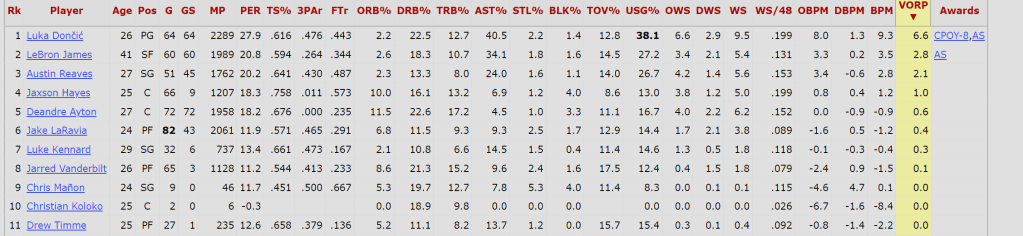
Lakers, 2025-2026: 2nd Round Exit. 5 players. Incredibly top heavy.
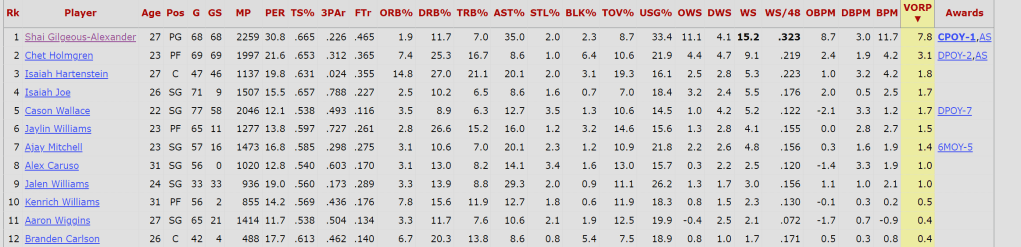
OKC Thunder, 2025-2026: Still playing in the playoffs. 10 Players.
The first statistical pass
I used 10 years of draft history, 2013 through 2022, first round only. That gives ten draft classes and avoids relying too much on incomplete Year 3 playoff evidence from newer classes.
I prefer the last 10 years because it better reflects the YouTube scouting era, where prospects are heavily covered and true information arbitrage is harder.
I used pick ranges instead of specific picks because drafts vary in quality and the sample sizes become too small.
How I classified players I classified each first-round pick by likely playoff value by the end of Year 3, not by career peak. VORP was only a rough screen. The final question was whether a serious playoff team could plausibly trust that player as one of its top eight. A player could clear the bar through shooting, defense, rim protection, creation, processing, rebounding, or matchup versatility. These tiers are judgment-based, so the percentages should be treated as directional rather than precise.
Here is the result:
Pick range
Sample
Tier 1: 16-game player
Tier 2: Starter
Tier 3: Premium starter
Tier 0: Replaceable
Median tier
1
10
90.0%
80.0%
50.0%
10.0%
2.5
2–3
20
85.0%
55.0%
35.0%
15.0%
2.0
4–5
20
65.0%
40.0%
20.0%
35.0%
1.0
6–10
50
46.0%
12.0%
2.0%
54.0%
0.0
11–14
40
57.5%
27.5%
15.0%
42.5%
1.0
15–20
60
38.3%
11.7%
1.7%
61.7%
0.0
21–30
100
36.0%
10.0%
3.0%
64.0%
0.0
How you can read this: if you had the 11th to 14th pick during the 2013 to 2022 timespan, you had a 57.5% chance of having a winning player (by the end of Year 3), a 27.5% chance of having a starter, and a 15.0% chance of having an upper-tier starter. You were more likely than not to get a 16-game player.
In general, the higher pick you have, the more success you have. This should surprise no one.
What surprised me:
The 6–10 range underperformed the 11–14 range in this first-pass sample.
That led to a hypothesis:
The 6–10 range may be where teams pay top-10 prices for theoretical upside. The 11–14 range may be where teams sometimes find players whose useful traits were discounted for the wrong reasons.
This does not mean picks 11–14 are inherently better than picks 6–10. In this sample, 11–14 produced starter outcomes more than twice as often as 6–10, which is unlikely to be a permanent truth about draft slots but may reveal something about how teams misprice different kinds of upside.
It also produced premium-starter outcomes at a much higher rate, 15.0% compared with 2.0%. Some examples are Tyrese Haliburton, Devin Booker, Donovan Mitchell, Shai Gilgeous-Alexander, Bam Adebayo, Domantas Sabonis, and Jalen Williams.
So what is going on here? And what can we learn from these failures and successes?
Please, NBA GMs: Avoid the Trap
The trap isn’t in falling for upside, it’s falling for fake upside.
Almost every lottery pick has tools. The question is whether the player already has something that works in the NBA, and whether that thing can survive in a playoff setting.
I would use three tests:
Does his best trait already matter in the NBA?
Does he have one bankable playoff skill plus one scalable trait?
Is the upside hidden, or does it require several uncertain things to improve?
1. Do not draft the multi-improvement parlay
“Maybe everything improves” is not a draft strategy.
The mistake is not betting on improvement. The mistake is betting on three improvements before the player has one usable NBA strength.
Range
Player
What was known pre-draft
What had to improve
Why it fits
6–10
Stanley Johnson, pick 8
He had the body teams love: size, strength, wing versatility, and defensive upside. Contemporary reports described him as a huge, physical wing and one of the better defensive prospects in the class.
Shooting, feel, offensive role, and enough skill to stay on the floor.
The defensive tools were real. The trap was assuming the offense would become good enough for the defense to matter in a playoff rotation.
11–14
Devin Booker, pick 13
The shooting was already bankable. Pre-draft reports described him as one of the best shooting-stroke prospects in college basketball, with size for a shooting guard and clear off-screen and spot-up value.
Creation growth and defensive survival.
Booker was not just “safe.” He had a bankable NBA skill, youth, touch, and enough size. The league discounted the creation upside because he was mostly seen as a shooter.
Takeaway: Booker did not hit because he was safer. He hit because his best trait already worked, and that trait gave him a runway to reveal more.
2. Prefer one bankable playoff skill plus one scalable trait
The ideal pick after the top tier is not the highest-ceiling player in the abstract.
It is the player with one skill that gets him on the floor, and one trait that can scale into starter value.
Range
Player
What was known pre-draft
Bankable skill or trap
Why it fits
6–10
Killian Hayes, pick 7
The positive case was size, ball-handling, passing, pick-and-roll feel, and lead-guard projection.
Trap: the passing only mattered if he became a real scorer or advantage creator.
Without scoring pressure, the passing and size package was not enough.
11–14
Tyrese Haliburton, pick 12
His useful traits were obvious: size, passing IQ, spot-up shooting, off-ball fit, and low-mistake play.
Haliburton did not need to become a different player before his strengths mattered. The league discounted the shot form and creation ceiling too much.
Takeaway: Hayes needed the scoring to arrive before the rest of the profile mattered. Haliburton’s decision-making already mattered.
3. Hidden upside is already real. Fake upside is imagined conversion.
Hidden upside means the player already has an NBA-relevant trait, but the market is discounting it because the player is older, smaller, weirder, quieter, from a less prestigious program, or harder to fit into a familiar archetype.
Fake upside means the player only becomes good if several uncertain things improve at once: the shot, the feel, the role, the defense, the body, or the decision-making.
That distinction matters because two players can look like “upside” bets on draft night. The difference is whether the upside is attached to something that already works.
The obvious danger is hindsight. After the fact, it is easy to say the hit had hidden upside and the miss had fake upside. That is not good enough.
The test has to be whether the distinction was visible before the draft. Did the player already have an NBA-relevant trait? Did that trait create a path to playoff minutes? Did the upside come from something real, or from assuming several weaknesses would all improve?
This framework will still miss. Some toolsy bets hit. Some skilled players never scale. The goal is not certainty. The goal is avoiding the most expensive mistake: paying lottery prices for a player whose case only works if everything changes.
The lesson is not to “draft safer players,” it’s to find players whose upside is being misread because their best traits are quieter, weirder, older, or harder to categorize.
Donovan Mitchell: messy archetype, real star traits
In 2017, Donovan Mitchell went 13th.
He had real star traits before the draft: burst, strength, defensive pressure, pull-up ability, length, and competitiveness. The market discounted him because he was not the cleanest archetype. He was considered undersized for a shooting guard, and there were questions about whether he could become enough of a lead creator.
Compare that to Frank Ntilikina at 8 and Dennis Smith Jr. at 9.
Their positives were also real. Ntilikina had size, length, and defensive tools. Smith had burst, handle, and athletic creation. The difference was conversion risk. Ntilikina needed the offense to catch up. Smith needed the athletic creation to become efficient, scalable offense. Mitchell’s burst, strength, shooting indicators, and competitiveness were already NBA-relevant.
Lesson: The market can overvalue clean tools and undervalue messy but functional star traits.
Shai Gilgeous-Alexander: quiet skill over loud tools
In 2018, Shai Gilgeous-Alexander went 11th.
He is the cleanest example of hidden upside, not fake upside. The positives were already visible: size, length, pace, craft, defensive playmaking, touch, and shooting indicators. The concern was that he was not explosive, not a clear elite shooter, and not yet a polished lead creator.
Compare that to Mo Bamba at 6 and Kevin Knox at 9.
Bamba had rare length, shot-blocking, and theoretical stretch-big upside. Knox had forward size, athleticism, and scoring flashes. Both had louder tools. SGA’s upside was quieter, but it was already in how he played: pace, processing, length, touch, and craft.
Lesson: Quiet skill can be better upside than loud tools.
Bam Adebayo: playoff skill hiding inside a “tweener” label
In 2017, Bam Adebayo went 14th.
The market saw a strong, explosive big with rebounding and finishing, but not a clean modern offensive role. The positives that mattered were already present: power, vertical athleticism, rebounding, hands, contact finishing, and defensive mobility.
Compare that to Frank Ntilikina at 8, Dennis Smith Jr. at 9, and Zach Collins at 10.
Ntilikina had size and defensive tools. Smith had athletic creation. Collins had size and big-man skill. Each still had to prove the strengths translated into a reliable playoff role.
Bam was discounted because he did not fit cleanly as a modern offensive big. But his real playoff trait was already there: switchable defensive force with power and mobility.
Lesson: Sometimes the market asks the wrong archetype question. Bam was not “what kind of offensive big is this?” He was “can this body, mobility, and strength become a playoff defensive weapon?”
The practical rule
Hidden upside starts with something real. Fake upside starts with a wish list.
After the clear top tier, the goal is not to find the most exciting theoretical player. It is to find the player whose current strengths already create a playoff path.
Why non-top-eight players do not justify the pick
If a player drafted in the first round becomes a top-eight playoff player, the rookie contract is valuable. A real 16-game player on a rookie-scale deal creates surplus value. A starter creates major surplus. A premium starter is the reason teams should still value the draft.
But if the player is not a top-eight playoff player by Year 3, the math changes.
At that point, the salary may still be fine. That is especially true outside the top 10. A late-lottery or mid-first rookie is not usually destroying your cap sheet.
The problem is not only the salary, it’s that you used the pick.
A player outside the playoff top eight is usually the kind of player teams can find another way. Minimum contracts, taxpayer midlevel signings, two-way players, G League development, reclamation projects, veteran specialists, and low-cost trades can all produce 9th to 15th men.
The bar for a first-round pick should not be:
Did he become playable?
The bar should be:
Did he become scarce?
If the answer is no, the team did not gain much. It bought a replaceable player at roughly market price, while spending a draft asset to do it.
In 2025-26, the NBA salary cap is $154.647 million. The taxpayer mid-level exception is $5.685 million. The room mid-level is $8.781 million. The non-taxpayer mid-level is $14.104 million. Those numbers are useful because they show the price range for players teams can acquire without using a premium draft asset.
A rough market ladder looks like this:
Player type
Market value
What it means
11th or 12th man
Minimum to low exception
Replaceable depth
9th or 10th man
Minimum to taxpayer mid-level
Useful, but not core
Fringe 8th man or matchup specialist
Taxpayer mid-level to room mid-level
Sometimes playoff-useful
Real 7th or 8th man
Room mid-level to full mid-level
Actual 16-game player
Starter
Above full mid-level
Scarce player
Premium starter
Max or not realistically available
Core asset
Now compare that to rookie-scale salaries. First-round picks can sign for 80% to 120% of the rookie scale. In practice, first-rounders usually sign at 120%, so that is the practical number to use. The 11th pick in the 2025 rookie scale was $5.715 million in Year 1, $6.001 million in Year 2, and $6.287 million in Year 3 at 120% scale.
(I am using 2025-26 cap and rookie-scale numbers as the current reference point. The exact 2026-27 numbers will change, but the strategic point should hold unless rookie salaries or exception salaries move dramatically out of proportion.)
Pick range
Approx. Year 1 salary at 120%
Approx. annual salary, Years 1-3
What it means if the player is below top eight
1
$13.8M
$14.5M
Clear failure
2-3
$11.7M
$12.3M
Clear failure
4-5
$9.5M
$10.0M
Clear failure
6-10
$7.0M
$7.4M
Probably overpaying for non-core value
11-14
$5.3M
$5.6M
Around the price of high-end depth
15-20
$4.1M
$4.3M
Salary is fine, asset cost is the issue
21-30
$3.0M
$3.2M
Cheap optionality
Pick 11 is right at the line where if it becomes a 9th man, the salary is probably fine.
The asset use is not fine, however – you spent the 11th pick to buy something the market can usually provide another way.
This is my point. Outside the top 10, the mistake is not always salary, it is is believing the player is strategically important when the most likely outcome is replaceable depth.
The financial comparison reinforces the point:
Draft result by Year 3
Basketball value
Market replacement
Draft implication
Below top eight
Useful inventory
Minimum to taxpayer mid-level
Not a meaningful first-round hit
Fringe 8th man
Matchup-dependent playoff player
Taxpayer mid-level to room mid-level
Useful, but not clearly scarce
Real 7th or 8th man
16-game player
Room mid-level to full mid-level
Meaningful hit
Starter
Top-five playoff player
Above full mid-level
Strong hit
Premium starter
Borderline All-Star or better
Max or unavailable
Core reason to keep high picks
The first-round pick only creates real surplus when the player becomes a true 16-game player or better.
If the player lands below that line, the team may not be hurt badly by the salary. But it probably lost the asset game.
Applying the framework to this draft
Now we can apply the idea to the 2026 draft.
For this draft, I separate the first tier before applying this framework. The public top tier appears to be AJ Dybantsa, Darryn Peterson, Cameron Boozer, and Caleb Wilson.
After that, I would not rank players by normal upside.
I would rank them by this:
Who is most likely to become one of the eight players a serious team can trust in a playoff series?
Then I would ask:
Inside that group, who has the best chance to become more than that?
The best later-lottery hits were not just safe role players. They were players with hidden star equity: Shai Gilgeous-Alexander, Donovan Mitchell, Devin Booker, Bam Adebayo, Tyrese Haliburton, Domantas Sabonis, and Jalen Williams.
The ranking below is my attempt to separate those two ideas before draft night, not after the fact.
Before ranking the group, it is worth remembering the base rate.
Using the 2013 to 2022 sample, if you are looking at the next 10 players after the top tier, roughly picks 5 through 14, history suggests something like this:
Expected outcome from 10 players after the top tier
Approximate count
Become playoff top-eight players
~5 (50%)
Become starters
~2 (20%)
Become premium starters
~1 (10%)
Fall below top-eight value
~5 (50%)
When we rank the next 10 players, we should assume about half of these lottery picks will not become the kind of player we are looking for.
A top-10 pick can remain employed and still fail the 16-game-player test. In my mind, that’s a bust.
How I generated the ranking
This is not a normal big board. I pressure-tested the group through several front-office lenses, using public scouting reports and AI-assisted synthesis to challenge my own priors: win-now playoff usefulness, long-term surplus value, shooting and processing, playoff defense and size, creation scarcity, production, market awareness, and anti-multi-improvement-parlay discipline.
One important guardrail: this board is not trying to be contrarian for its own sake. The framework is useful only where it explains either why consensus is right, why consensus is overpaying for fake upside, or why a useful player is being discounted for the wrong reason.
The players who held up best were not always the biggest upside bets. They were the players whose current strengths translated across the most versions of the test.
Rank the players by the probability of becoming a top-eight playoff rotation player, then use starter and premium-starter upside as the tiebreaker.
Run
Emphasis
1
Balanced 16-game-player framework
2
Win-now playoff usefulness
3
Long-term surplus value
4
Shooting and processing
5
Playoff defense and size
6
Creation scarcity
7
Production and statistical indicators
8
Anti-multi-improvement-parlay discipline
9
Market and consensus awareness
10
Upside, but only where the upside is already connected to real skills
Where the framework changes the board The framework is useful only if it changes decisions. It raises players whose best traits already create a playoff pathway, even if their upside looks quieter. It lowers players whose case depends on several things improving at once. That is the difference between hidden upside and imagined upside.
Player
Normal appeal
Framework read
Keaton Wagler
Clean guard skill, shooting, feel
Stays high because the core traits already translate.
Darius Acuff Jr.
Best guard-star upside
High, but not first because small-guard creation has more playoff failure modes.
Yaxel Lendeborg
Older, lower star upside
Higher if the goal is real Year 3 playoff trust.
Nate Ament
Premium big-wing archetype
Lower because too much depends on strength, defense, finishing, and role clarity improving together.
My top 10 outside the first tier
This is a 16-game-player board.
The board uses four filters: usable NBA strength, bankable playoff skill, scalable trait, and low dependence on a multi-improvement parlay.
I separate the group into probability tiers first. Then I use starter and premium-starter upside as the tiebreaker. The tiers matter more than the exact order. Overall rank reflects my estimate of 16-game-player probability. Star upside is discussed in the writeups.
Overall Rank
Player
Read
5
Keaton Wagler
Tier A. Cleanest playoff path.
6
Darius Acuff Jr.
Tier A. Best star upside in the tier.
7
Brayden Burries
Tier A. Strongest connector profile.
8
Kingston Flemings
Tier A. Best athletic upside bet.
9
Yaxel Lendeborg
Tier B. Safest immediate playoff role.
10
Labaron Philon Jr.
Tier B. Best Tier B scoring upside.
11
Karim López
Tier B. Clear role-player-plus case.
12
Mikel Brown Jr.
Tier C. Volatile advantage-creation bet.
13
Nate Ament
Tier C. Big-wing upside, big parlay risk.
14
Aday Mara
Tier C. Skilled center, mobility question.
Where this board could be wrong
The strongest argument against this board is that the framework is clearer than the ranking.
A skeptic could accept every premise in this piece and still say:
I buy that the goal is a top-eight playoff player. I buy that fake upside is dangerous. I buy that non-scarce players are replaceable. But how do I know this board is not just a normal public big board with better language around it?
That is a fair objection.
Several of these players are already clustered in the same range on public boards. Keaton Wagler, Darius Acuff Jr., Brayden Burries, Kingston Flemings, Mikel Brown Jr., Yaxel Lendeborg, Labaron Philon Jr., Aday Mara, Nate Ament, and Karim López are not obscure names.
So the point is not that this board is wildly different from consensus. The point is to identify which consensus prospects are supported by a real playoff pathway, and which ones are mostly being held up by theoretical upside.
The better question:
Where does the framework create a different decision than a normal big board?
Tier A: Best balance of playoff floor and starter upside
5. Keaton Wagler
Wagler ranks first because shooting, feel, tempo, size, and secondary creation are already playoff-relevant. His case does not require him to become a different player before he helps.
The upside is that a big guard with shooting and processing can scale into more creation over time. That is the Booker / Haliburton pattern, not because he is those players, but because the market can underrate players whose best traits look too clean or too safe.
The objection is that consensus may already price this in. He may not be a hidden-value pick. He may simply be a good prospect who goes where he should. The real risk is that limited burst and strength cap his rim pressure, defensive versatility, and premium-starter upside.
He drops if he cannot pressure the rim or guard stronger wings. He stays high if the shooting and processing are good enough to keep him on the floor while the creation grows.
6. Darius Acuff Jr.
Acuff has the best star upside in Tier A because self-creation is the rarest skill. If he becomes an efficient advantage creator, he can beat this ranking.
The reason he is not first is that creation prospects are where teams often overpay for fake upside. The scoring has to be efficient enough to bend defenses, and the defense has to be passable enough that he does not become a playoff target.
That is the Mitchell vs. Dennis Smith Jr. fork. The athletic creation is exciting, but it has to become scalable offense.
He rises if the scoring pressure is real enough to force rotations. He drops if he becomes a high-usage guard whose efficiency and defense do not survive playoff matchups.
7. Brayden Burries
Burries has the cleanest complementary playoff profile in Tier A. Strength, shooting, rebounding, and low-mistake play give him a visible path to being trusted in a playoff rotation.
The upside is not loud, but it is functional. He does not need to become a primary creator to matter. He needs the shot, physicality, and decision-making to hold while the creation becomes good enough to punish tilted defenses.
The objection is scarcity. If the creation does not scale, he may become more “good player” than true surplus asset.
He drops if the shot is only fine and the handle does not create advantages. He rises if the passing, strength, and shooting turn him into a Jalen Williams-style connector with more on-ball value than expected.
8. Kingston Flemings
Flemings is the athletic upside bet in Tier A. Speed, rim pressure, passing feel, and defensive tools give him a real hidden-upside case.
The key distinction is that his upside is tied to how he already plays. This is not just a body or tools bet. If the speed and feel translate, he can pressure the rim, collapse defenses, and make enough reads to become more than a straight-line athlete.
The objection is playoff targeting. Size, shooting, and half-court finishing all matter more when the game slows down. If those do not translate, he becomes closer to the athletic-guard conversion trap.
He drops if the jumper and finishing do not hold. He rises if the speed creates efficient paint pressure and the defense is strong enough to survive matchups.
Tier B: Clean 16-game bets, thinner star path
9. Yaxel Lendeborg
Lendeborg may be one of the safest players in this group to become a playoff rotation piece. He defends, rebounds, passes, and plays physically. The role is easy to see.
The question is not whether he can help. The question is whether he creates enough surplus value to justify the pick. If the goal were only “who helps a playoff team soonest,” he might be higher.
The reason he is in Tier B is that age narrows the premium-starter path. He is a strong 16-game bet, but not a clean star bet.
He rises if the shooting is real enough to keep him on the floor in more lineups. He drops if teams can ignore him offensively or force him into a narrow frontcourt role.
10. Labaron Philon Jr.
Philon has the best star upside in Tier B because scoring craft matters. The market question is whether his skill is being discounted too much because of size and athletic skepticism.
That is a legitimate hidden-upside setup. Crafty guards can look less impressive than explosive guards before the draft, then become more valuable because the skill actually translates.
The objection is playoff defense. Smaller guards have to be good enough offensively to justify the pressure they absorb defensively. If he gets hunted, the craft may not be enough.
He rises if he creates efficient paint pressure and defends well enough to stay on the floor. He drops if he becomes a regular-season scoring guard without a clean playoff role.
11. Karim López
López has a clear role-player-plus case. Size, motor, defense, cutting, and professional experience make the role easy to see.
The appeal is role clarity. You do not have to invent a use case for him. If the offense holds, he can fit into serious lineups as a low-usage forward who defends, runs, cuts, and keeps the ball moving.
The objection is scarcity. Useful is not the same as scarce. If the shot and on-ball value do not grow, he may become a good bench forward rather than a meaningful first-round hit.
He rises if the shooting and on-ball flashes become credible. He drops if he is mostly an energy forward without enough offensive threat.
Tier C: Volatile but defensible upside swings
12. Mikel Brown Jr.
Brown is the easiest player in this range to imagine beating the board. Passing and ball-screen feel are real advantages if they come with enough scoring pressure.
The upside case is that advantage creation is scarce. A guard who can run offense, manipulate coverages, and create shots for others has real playoff value if the rest of the profile holds.
The risk is that this becomes the Killian Hayes problem. Passing only matters if the player can also score or create enough pressure to make the defense react. If scoring, strength, defense, and medicals all have to cooperate, the profile becomes a multi-improvement parlay.
He rises if he creates efficient pressure without being hunted. He drops if the passing is real but the scoring pressure is not.
13. Nate Ament
Ament has the rarest archetype left on the board: a big wing with shooting and handling flashes. That kind of player is too valuable to dismiss.
This is the exact kind of profile that can make a team look wrong in both directions. Pass on him, and he could become the oversized wing creator every team wants. Draft him too high, and you may have bought the idea of a player before the player exists.
That is why he stays in the top 10 but remains in Tier C. Strength, finishing, defense, consistency, and role clarity all need to move in the right direction.
He rises if the physicality and defensive reliability catch up to the skill flashes. He drops if the archetype is more appealing than the actual playoff role.
14. Aday Mara
Mara has real center skill. Size, rim protection, touch, and passing feel give him a path to more than backup value.
The question is playoff mobility. Modern playoff basketball forces centers to survive in space, defend multiple actions, and avoid being played off the floor by matchup hunting.
If Mara can survive those conditions, he is a legitimate top-eight playoff rotation player. If he cannot, he becomes matchup-dependent.
He rises if the mobility is good enough to stay on the floor against spacing. He drops if teams can pull him away from the rim and attack him repeatedly.
Final rule
For teams picking after the clear top tier, the rule should be simple:
Draft the player with one real playoff trait and a credible path to scale. If that player is not there, trade the pick while it is still hope.
Giannis Antetokounmpo is reportedly back on the NBA trade market, and it sounds like this will be done before the 2026 NBA draft. Since the Warriors were part of the rumors this last season, I wanted to review where they realistically stand. My prediction is simple:
Houston gets the deal done for Alperen Sengun, Jabari Smith Jr., and a future first for Giannis.
But first, let’s discuss the assumptions in my argument.
Core Assumptions
The Bucks have already decided to trade Giannis before the draft.
They need a coherent public story the day after the trade. The return must be clear to fans, media, ownership, and the locker room.
They are not set up for a clean tank. Their future draft-pick control is compromised. Losing more games is not necessarily beneficial, especially considering the proposed draft lottery restructuring built to deincentivize tanking.
They already have No. 10 in the 2026 draft. The ideal trade either adds another premium draft asset or adds a young player who functions like one.
Giannis has practical destination leverage. Because of his contract situation, teams will not pay full value unless they believe he will accept the destination.
Bucks Strategic Assumptions
They want a reset, not a full teardown. The likely goal is to become younger, cheaper, and more flexible, not to become the worst team in the league.
They need at least one fan-facing centerpiece. The return needs someone fans can immediately understand as part of the next era.
They will prefer immediate or near-immediate value over vague distant upside. A 2026 lottery pick matters because it can be used right away. A young player already producing matters because fans can see the new direction immediately.
They will discount distant future picks unless there is a clear reason to believe those picks could become premium assets.
They do not want an old star as the main return. Older stars matter only if they can be rerouted for younger assets or picks.
They will value clean salary and contract flexibility. In a Giannis trade, getting off Myles Turner’s remaining money could be part of the value.
Below I rank the deals that I think could actually get agreement from Milwaukee, the acquiring team, and Giannis himself.
My Prediction: Houston Gets the Deal Done
Houston: Alperen Sengun, Jabari Smith Jr., 2027 #1 routed from Phoenix Milwaukee: Giannis
Houston is the cleanest “win-now urgency” bidder because its timeline has already shifted. The Rockets are no longer patiently collecting prospects around Sengun, Jabari Smith Jr., Reed Sheppard, Amen Thompson, and future picks.
By adding Kevin Durant, they moved into a shorter contention window, which makes a second consolidation trade more defensible. Sengun is young and productive, but his best role is as an offensive hub, and Houston may decide that Giannis gives them a higher playoff ceiling next to Durant, Amen, and their remaining defensive infrastructure.
From Milwaukee’s side, Sengun + Jabari + a premium first is one of the few packages that gives the Bucks both salary matching and a coherent post-Giannis story: a young All-Star-level center, a young stretch forward, their own No. 10 pick, and another future draft asset.
This deal is painful for Houston, but they would still have Giannis, Durant, Amen Thompson, (and likely, Fred VanVleet) and enough defensive infrastructure to be a real contender.
A Clean Reboot: Golden State Warriors
Golden State: Brandin Podziemski, Moses Moody, Jimmy Butler, No. 11 + 3 other first round picks Milwaukee: Giannis, Myles Turner
The Warriors can give the Bucks a full reboot package: immediate draft capital, young rotation pieces, short-term salary, long-term cap cleanup, and future exposure to a declining franchise.
If Giannis is gone, Myles Turner’s remaining long-term money becomes much harder to justify on a reset roster. Golden State can absorb that contract because Turner still helps a Curry-led title push as a stretch big and rim protector.
In return, Milwaukee gets Podziemski, a former Wisconsin Mr. Basketball, Moody, Butler’s expiring salary, No. 11 next to its own No. 10, and three others first round picks.
Moody’s injury lowers his value, but he is still young and on a manageable deal. Butler is expiring salary who could be traded (or more simply, bought out) to a contending team before the 2027 trade deadline.
Podziemski is the key young player in the deal. I am assuming he can be re-signed around $15 million to $20 million per year, which would make him a useful long-term contract for Milwaukee. At that number, he fits the reboot story as a young, productive guard next to two lottery picks. If he costs meaningfully more, his value to Milwaukee drops.
The Bucks argument is that this deal lets them reboot immediately: two adjacent lottery picks, two young rotation players, future post-Curry picks, and a clean break from both the Giannis era and the Turner (3 years, near $90M) contract.
Cleanest Bucks Fit, But Less Likely: San Antonio Spurs
San Antonio: Stephon Castle or Dylan Harper + Devin Vassell + Keldon Johnson Milwaukee: Giannis
The Spurs are young, good, and can keep following the OKC-style homegrown path. The deal only makes sense if they feel urgency to win it all now. Giannis next to Wembanyama would be an absurd defensive frontcourt, but the cost is abandoning the Spurs’ young core as it is starting to prove itself.
Castle or Harper is the type of young player Milwaukee can sell as the next era. Vassell and Keldon Johnson are included for salary matching, but are also good fair contract young players. This deal doesn’t need a draft pick.
For Milwaukee, this is probably the cleanest young-player package. The Bucks get a potential supestar guard, useful salary, and a reset story that makes sense.
I do not think the Hawks include No. 8. If No. 8 and No. 23 are both included, the package is very attractive for Milwaukee.
The other key piece is Nickeil Alexander-Walker, this last season’s most improved player. I do not think Atlanta includes him because he is an amazing value at his contract. If he is in the deal, things look very different for Milwaukee. But if Atlanta is trying to build around Jalen Johnson, and Giannis, Walker is exactly the type of reasonably priced two-way player they should want to keep.
The broader issue with Atlanta is that their young players are all useful, reasonably priced, and under team control. Dyson Daniels is good, but flawed. It is not clear he can become a good enough offensive player. Risacher (former #1 overall pick) had a very shaky second year, so his stock is down. Okongwu is solid, but his development has been slow enough that the ceiling is unclear.
Atlanta has the assets to make a deal happen, but the version they would want to offer probably is not strong enough to beat Houston, San Antonio, or Golden State.
My Ranking
Houston: my prediction to land him
Golden State: cleanest full reboot package
San Antonio: cleanest Bucks young-player package, but less likely
Atlanta: best almost-deal, probably not enough without No. 8 or Walker
But What About XYZ Team?
Note: I did not go deeply into the salary structure for each team below to see if deals are actually possible. I just looked at the core proposal to “get close.”
The pick counts below are conservative estimates. I am excluding swaps, encumbered picks, and picks that may not be legally tradable.
Team
Clean tradable firsts
Bucks want
Why it fails / who says no
Memphis
~5: No. 3, No. 16, 2028, 2031 PHX, 2032
No obvious centerpiece
The picks are strong, especially No. 3, but Giannis acceptance is the blocker. Bucks do not have clear value for Ja Morant in this type of reset.
Clippers
~3-4: No. 5, 2030, 2032, maybe 2029 IND
No obvious centerpiece
Bucks say no unless they love No. 5 or a first-tier player falls. The pick has to carry too much of the package. Clippers’ future sheet is messy after No. 5.
Lakers
~3: No. 25, 2030, 2032
Austin Reaves
Bucks say no. Reaves is good and marketable, but not enough as the main Giannis return at likely $40M+ money.
Heat
~3: No. 13, 2030, 2032
Tyler Herro or Bam Adebayo
Bucks say no on a Herro-led package. A Bam package is more interesting, but Miami probably does not trade Bam if the goal is to pair him with Giannis.
OKC
~3: No. 12, No. 17, one of 2031/2032 under strict rule
Chet or Jalen Williams
OKC says no. They can pay their existing players and are already championship level. They have no need to compress the timeline. OKC has plenty of other young talent that would be attractive, but I just don’t think OKC cares.
Celtics
~3: No. 27, 2027, 2030 or 2031
Jaylen Brown
Celtics probably say no if Jaylen is required. Bucks say no if he is not. Late picks do not carry the deal.
Cavaliers
~3: No. 29, 2030, 2032
Evan Mobley
Cavs say no on Mobley. Bucks say no without Mobley because the picks are not good enough.
Knicks
~3: No. 24, 2030, 2032
No obvious centerpiece
Bucks say no unless a core player is included. The pick package is too thin.
Magic
~1: 2032 only under strict rule
Franz Wagner
Bucks say no because there is no 2026 first and little clean pick flexibility.
Timberwolves
~1: No. 28 only under strict rule
Jaden McDaniels
Bucks say no. Minnesota lacks clean tradable firsts and cannot beat the market without a core player.
Nuggets
~1: No. 26 only under strict rule
Jamal Murray or Peyton Watson
Both sides probably say no. Denver lacks clean picks and does not have a clean Bucks-facing package.
Cycling is a serious hobby for me, but my professional background is in building technology companies. Because of that, I often find myself thinking about the business side of the cycling industry.
Over the past several years I’ve purchased carbon wheels from a number of direct manufacturers, including Light Bicycle, Light Travel, DFS, and others selling through AliExpress. One thing has become clear: many factories are now capable of producing excellent wheels, often comparable in performance to well-known Western brands.
At the same time, the market has become crowded and confusing for riders. Many companies sell similar products, and it’s not always clear which brands are trustworthy.
This led me to a simple question:
What would a modern direct-to-consumer wheel brand look like if it were designed from scratch today?
The document below is an attempt to answer that question. I originally wrote it as a strategy memo to share with a few manufacturers, but I thought it might also be interesting to riders and others who follow the cycling industry.
It’s not a business plan — just a thought experiment about how manufacturing capability, simple product design, and creator-driven distribution might combine to build a new kind of cycling brand.
I have spent many years starting and running technology companies, including products that reached millions of users in the United States and Vietnam.
Cycling has also been a serious personal hobby for many years. Because of that, I often think about the business side of cycling and how new companies can succeed.
Over the past several years I have purchased and ridden carbon wheels from a variety of direct manufacturers, including companies such as Light Bicycle, DFS, and other vendors selling through AliExpress and independent websites. These experiences have helped me understand both the strengths of these products and the challenges Western riders face when deciding which brands to trust.
Many Chinese manufacturers are now capable of producing carbon wheels with excellent engineering and competitive pricing. In many cases, these products are comparable in quality and performance to wheels sold by well-known Western brands.
However, many Western riders still hesitate to purchase directly from overseas manufacturers.
The reasons are usually not the product itself, but concerns such as:
uncertainty about quality control
uncertainty about customer support
difficulty knowing which brands are trustworthy.
At the same time, the carbon wheel market has become crowded. Many companies sell similar products, but the differences between brands are often unclear to customers.
Because of this, there is a clear opportunity.
If manufacturing excellence can be combined with clear brand positioning and modern distribution channels, it may be possible to build a trusted direct-to-consumer wheel brand for Western riders.
The Model in One Page
The Opportunity
Chinese manufacturers are already producing high-quality carbon wheels.
However, many Western riders still lack confidence when buying directly from overseas brands.
A brand that clearly communicates trust, simplicity, and value could solve this problem.
The Concept
A modern wheelbuilder brand built around three principles:
Benchmark wheels Wheels designed around the most respected categories in the market.
Simple pricing All wheels priced at:
$999 delivered
Creator collaboration Cycling content creators design wheel builds and explain them to their audiences.
Business Structure
Manufacturer → builds high-quality wheels
Creators → design builds and share their experience
Riders → purchase trusted wheels at a fair price
Brand Philosophy
The philosophy of the brand can be summarized in three lines:
99% of the performance No hype $999 delivered
Great wheels come from:
proven rim designs
reliable components
careful wheelbuilding practices.
The goal is not to invent new wheel technology.
The goal is to apply proven engineering principles, similar to how respected wheelbuilders operate.
Product Strategy (Benchmark Wheels)
The product lineup should follow the most respected categories in the cycling market.
Instead of inventing new product segments, the goal is to build wheels that match the purpose of the best wheels already available.
Core wheel platforms:
Wheel
Depth (F/R)
Category
Climb
35 / 40
climbing road
Allroad
40 / 50
everyday road
Aero
50 / 60
aero road
Gravel
40 / 45
gravel race
These four wheels cover the majority of riders.
Benchmark Comparison
Category
Benchmark Wheel
Depth
Typical Price
Our Wheel
Depth
Price
Climbing Road
ENVE SES 3.4
38/42
~$2550
Climb
35/40
$999
All-Around Road
Reserve 42/49
42/49
~$2400
Allroad
40/50
$999
Aero Road
ENVE SES 4.5
50/56
~$2850
Aero
50/60
$999
Gravel Race
Zipp 303
40/40
~$2100
Gravel
40/45
$999
The goal is not to copy products, but to match the same performance categories.
Creator Collaboration Model
Another key part of the strategy is working with cycling creators.
Many riders learn about equipment through YouTube, Instagram, and other content platforms.
Instead of traditional sponsorships, creators can design their own preferred wheel build using the core platforms.
Creators can choose:
hub configuration
spoke type
spoke count.
They explain why they chose the setup and ride the wheels publicly.
Riders can then purchase the same configuration.
Creator Revenue Model
All wheels remain priced at:
$999 delivered
The manufacturer keeps the normal production margin.
Remaining margin can form a creator revenue pool.
Creators can influence their earnings based on configuration choices:
premium hubs → lower margin
simpler configurations → higher margin.
This keeps the model simple and transparent.
Launch Plan
The concept can begin as a small experiment.
It does not require large investment.
Step 1 – Simple Website
Build a simple website focused on:
the people behind the wheels
the company story
brand philosophy
wheel lineup
creator builds.
The site should feel like a modern wheelbuilder workshop.
Example costs:
Website platform: ~$50/month Domain: ~$25/year
Step 2 – Simple Ordering
Initial orders could be handled through:
PayPal invoices
email
WhatsApp support.
This keeps operations simple while testing demand.
Step 3 – Creator Testing
Start with 2–3 creators.
Each creator could test up to four wheelsets.
Examples:
Allroad 40/50
Aero 50/60
Gravel 40/45.
Creators may launch their own builds or simply produce review content.
Possible content includes:
ride testing
wheel design discussions
wheelbuilding process
behind-the-scenes videos.
Why This Is Worth Trying
This strategy requires very little upfront investment.
Most manufacturers already have the most important capability:
the ability to build excellent wheels.
Testing the idea only requires:
a simple product lineup
a simple website
a small number of creator partnerships.
If the idea succeeds, it could grow into a strong direct-to-consumer wheel brand.
If it does not succeed, the cost of testing the concept is very small.
Closing
I wrote this proposal because I believe Chinese manufacturers have a unique opportunity in the Western cycling market.
Manufacturing capability already exists.
With a clear brand story and modern distribution through creators, it may be possible to build a trusted wheel brand for Western riders.
Even if this exact strategy is not adopted, I hope these ideas are helpful.
If you would like to discuss the concept further, I would be happy to talk.


 I Spit Hot Fire